Lens types
Single visionedit
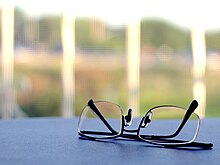
Single vision lenses correct for only one distance. If they correct for far distance, the person must accommodate to see clearly up close. If the person cannot accommodate, they may need a separate correction for near distances, or else use a multifocal lens (see below).
Reading glasses are single vision lenses designed for near work, and include over the counter glasses. They come in two main styles: full frames, in which the entire lens is made in the reading prescription, and half-eyes, style glasses that sit lower down on the nose. Full frame readers must be removed to see distance clearly, while the distance can be clearly viewed over the top of half-eye readers.
Bifocaledit
A bifocal is a lens with two sections, separated by a line (see image to the right). Generally, the upper part of the lens is used for distance vision, while the lower segment is used for near vision. The area of the lens that caters to near vision is called the add segment. There are many different shapes, sizes, and positions for the add segment that are selected for functional differences as well as the visual demands of the patient. Bifocals allow people with presbyopia to see clearly at distance and near without having to remove the glasses, which would be required with single vision correction.
Trifocaledit
Trifocal lenses are similar to bifocals, except that the two focal areas are separated by a third area (with intermediate focus correction) in the middle. This segment corrects the wearer's vision for intermediate distances roughly at arms' length, e.g. computer distance. This lens type has two segment lines, dividing the three different correcting segments.
Progressiveedit
Progressive addition or varifocal lenses provide a smooth transition from distance correction to near correction, eliminating segment lines and allowing clear vision at all distances, including intermediate (roughly arms' length). The lack of any abrupt change in power and the uniform appearance of the lens gives rise to the name "no-line bifocal".
Multifocaledit
Multifocal contact lenses (e.g. bifocals or progressives) are comparable to spectacles with bifocals or progressive lenses because they have multiple focal points. Multifocal contact lenses are typically designed for constant viewing through the center of the lens, but some designs do incorporate a shift in lens position to view through the reading power (similar to bifocal glasses).
Adjustable focusedit
The power or focal length of adjustable or variable focus can be changed to suit the needs of the wearer. A typical application of such a lens is to refocus the correction allowing clear vision at any distance. Unlike with bifocals, near-vision correction is achieved over the entire field of view, in any direction. Switching between distance and near vision is accomplished by re-adjusting the lens, instead of by tilting and/or rotating the head. The need for constant adjustment when the person's attention switches to an object at a different distance is a design challenge of such a lens. Manual adjustment is more cumbersome than bifocals or similar lenses. Automated systems require electronic systems, power supplies, and sensors that increase the cost, size, and weight of the correction.
Planoedit
A corrective lens with a power of zero is called a plano lens. These lenses are used when one or both eyes do not require correction of a refractive error. Some people with good natural eyesight like to wear eyeglasses as a style accessory, or want to change the appearance of their eyes using novelty contact lenses.


Comments
Post a Comment